

 Licensing drag
 Stored procedure risk
 Inconsistent output
 Cutover anxiety


90%
Faster migration timelines


Proteus assesses, converts, tests and deploys your database code through a rules-first pipeline you can audit line by line. Same input, same output, every run.
Most modernization plans stall at the database. The schema is the easy bit. The real work sits in thousands of stored procedures, functions, triggers and inline queries that encode years of business rules, and every one of them has to behave the same way on PostgreSQL as it did on SQL Server or Oracle.
Meanwhile the licence bill keeps coming. SQL Server 2016 reached end of support in July 2026, so teams still on it are paying for software that no longer gets security fixes.
That's months of developer-by-developer rewrites, each with its own quality.
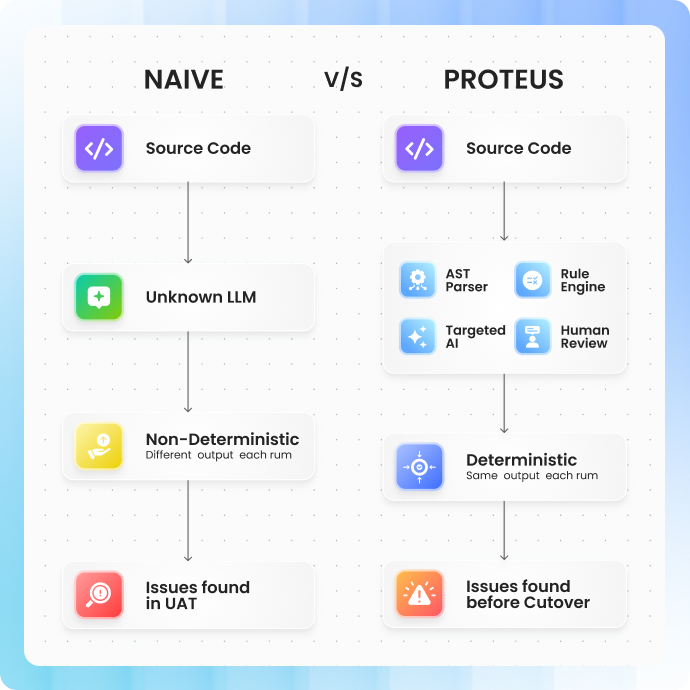
It's fast but unpredictable: run the same procedure twice and you can get two different answers, and the problems show up in UAT.
Oracle and SQL Server licences eat budget that could fund the move to AI-ready platforms.
Business-critical logic buried in T-SQL and PL/SQL is where manual migrations break.
Manual rewrites and pure-LLM tools produce different results for the same code.
Without automated testing, nobody can prove the new database behaves like the old one.
Some migration tools send your source code to a language model as-is and hope for the best. Proteus doesn't.
It parses your source database into a structured model, then runs the bulk of the conversion through a migration rule engine. AI is brought in for the cases that need judgement, and anything complex is flagged for a human to review. That design choice is why the output is repeatable, why it can be audited, and why it costs less to run.
The same procedure converts the same way on every run. You can re-run the pipeline after a schema change and trust the diff.
Conversion logic lives in an open, extensible migration-rules.json file. Your architects can inspect it, customize it and add rules for your own patterns.
Because the rule engine does the heavy lifting, token use stays low. Proteus tracks it at job, project and user level, so you see exactly what AI is costing you.
Every stage runs with quality gates and progress tracking, so you always know what’s converted, what’s tested and what needs a person.
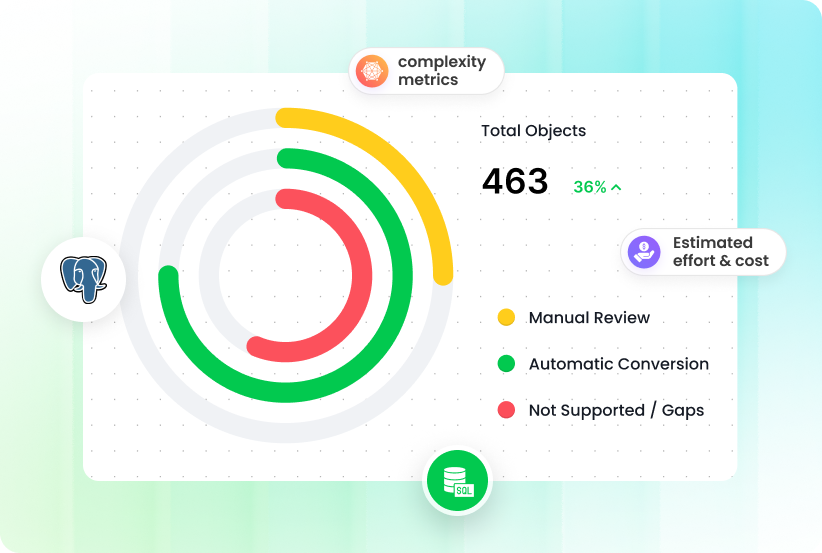
Proteus scores migration readiness before a single line is converted. It analyzes schemas, stored procedures, queries and dependencies and tells you:
You get a migration plan with effort and risk scoring, not a guess.
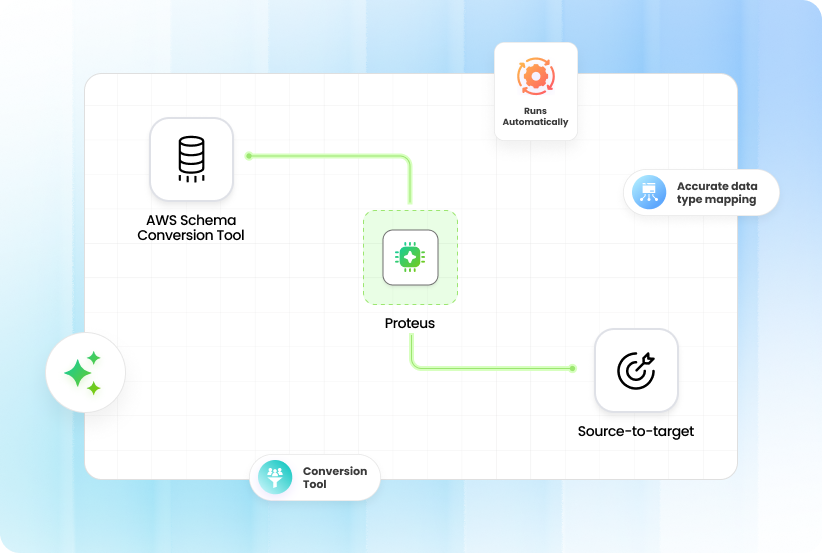
Source-to-target schema mapping runs automatically using AWS Schema Conversion Tool combined with Proteus conversion logic, with accurate data type mapping.
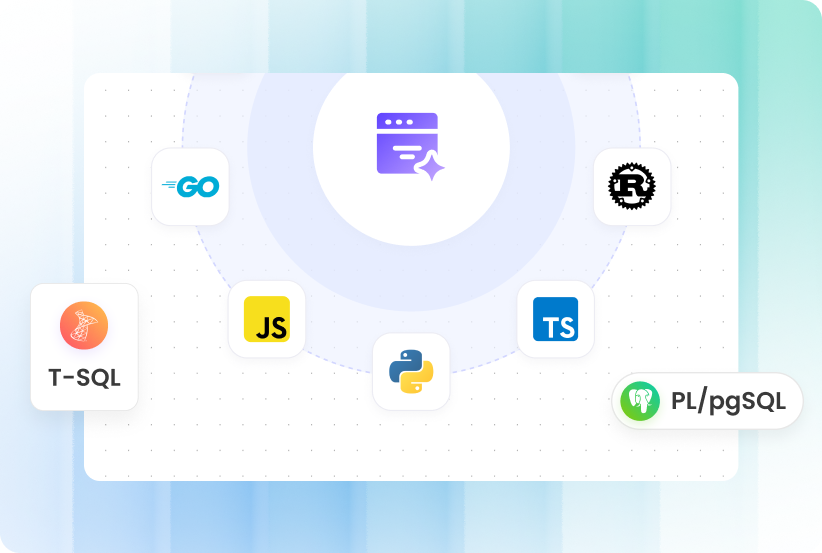
T-SQL is converted to PL/pgSQL, covering stored procedures, functions and inline queries embedded in application code. Conversion is dependency-aware, so objects are processed in the right order and relationships stay intact.
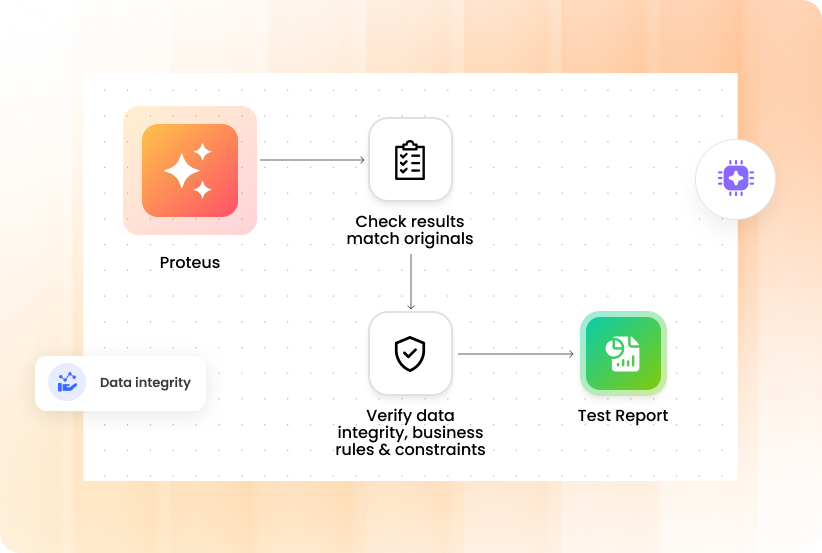
Proteus generates and runs unit tests to check that converted procedures and functions return the same results as the originals, that data integrity holds across tables and relationships, and that business rules and constraints survive. You get a test report for every object.
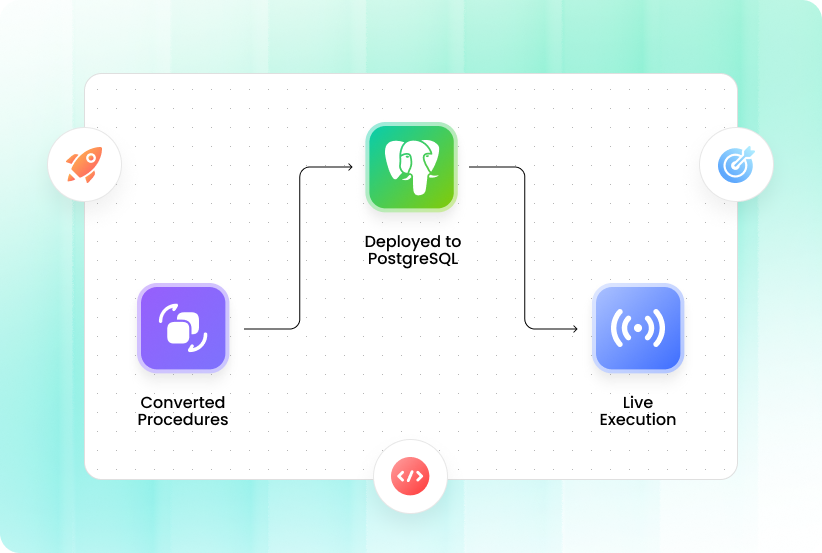
Converted procedures are deployed to your PostgreSQL target and checked to confirm they execute correctly there, not just that they compile.
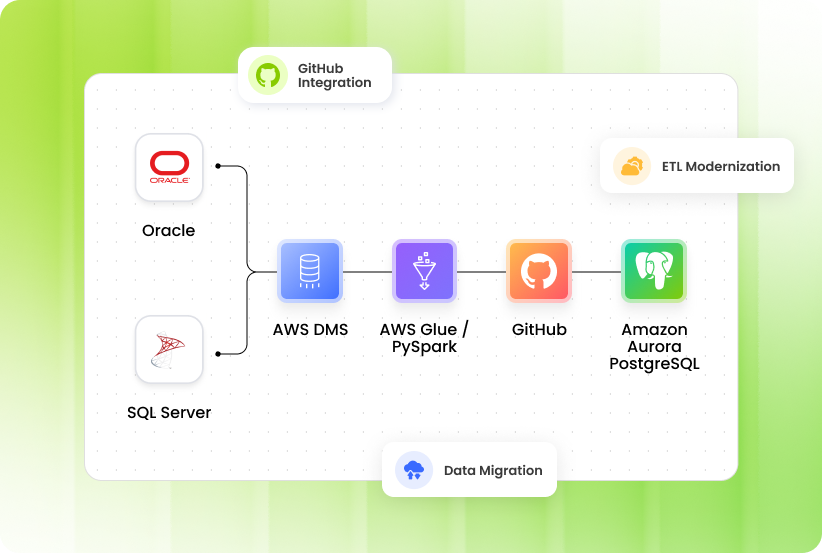
Proteus was built over several months with AWS stakeholders across the APJ and worldwide modernization teams. It runs as a native skill on AWS Transform, so it slots into the migration tooling AWS already recommends, alongside AWS Schema Conversion Tool and AWS Database Migration Service.
Native AWS Transform skill, built on AWS Transform composability
Validated by the AWS APJ Modernization team, and demonstrated to AWS India and US modernization teams
Amazon Aurora PostgreSQL
Eligible migrations may qualify for AWS partner funding programs, including funded modernization assessments. Ask us what applies to you
90%
Faster migration timelines
~60%
Lower migration cost
95%
Less manual code review
100%
Auditable, repeatable conversion
Disclaimer : Indicative figures based on SourceFuse delivery experience. Actual results depend on project scope, complexity, environment and client requirements.
We run Proteus against your environment first, so you see real output before you sign up for a full migration.
Book a migration assessment


your SQL Server or Oracle environment and migration complexity

with effort and risk scoring for every object


it with a sample conversion and test results on your own code
Send us a sample and we'll show you the conversion, the tests and the migration plan.
